

REVIEW · OSLO TOURS
Central Oslo Guided Walking Tour with Local Guide
Oslo earns its nickname fast, thanks to a start at Tigeren. This two-hour walk strings together the big symbols of the city with a local guide and stops that are mostly outdoors, so it feels efficient without feeling rushed. I love the Tiger City photo moment at Jernbanetorget, and I also love how the local guide turns architecture and politics into easy, fun stories. My one caution is simple: this is an exterior-only route, so if you want museum interiors, you’ll need to plan those separately.
You’ll cover a lot of ground on foot, and the pace depends on your group size and the guide on the day. Also, it runs best when weather cooperates, because it’s designed for walking.
In This Review
- Key highlights to know before you go
- A two-hour walk that covers central Oslo’s “must-see” anchors
- Starting at Tigeren pa Jernbanetorget, Oslo’s Tiger City clue
- Oslo Opera House and Rådhusgata, new architecture plus old street life
- Akershus Fortress: medieval protection, now a museum site
- Oslo City Hall and Nobel Peace Prize vibes, without the ticket hassle
- Oslo Cathedral and Karl Johans gate, the Baroque landmark and the main drag
- Aker Brygge waterfront and the Storting building, democracy meets the docks
- Ending at the Royal Palace square, your next-day planning starts here
- Price and value: why about $16.94 feels fair for two hours
- Pace, group size, and whether this walk fits your day
- The main tradeoff: exterior views only, so bring a plan for what’s next
- Who should book this Oslo guided walk
- Should you book this Oslo walking tour?
- FAQ
- How long is the central Oslo guided walking tour?
- What does the tour cost per person?
- Is the tour offered in English?
- Does the tour include visits inside buildings?
- Where does the tour start and end?
- What is the group size limit?
- What happens if the weather is bad, or I need to cancel?
Key highlights to know before you go
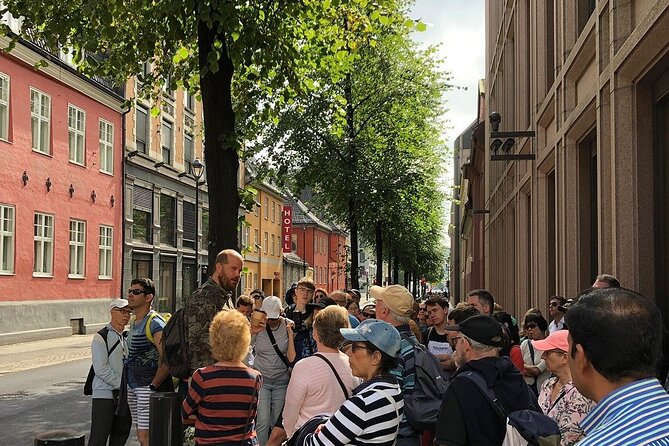
- Tiger Statue at Jernbanetorget sets the tone right away with Oslo’s millennium-era symbolism
- Oslo Opera House exterior gives you that signature waterfront look without a museum ticket
- Akershus Fortress and City Hall pack medieval defense and Nobel Prize prestige into one easy loop
- Karl Johans gate and Oslo Cathedral show the city’s Baroque side and its main-street energy
- Storting building and Aker Brygge connect democracy and waterfront life before you finish at the Royal Palace
Capital bookings past this listing, Oslo graded again
- Oslo: Scenic Fjord Cruise with Audio Guide Commentary★ 4.5 · 5,375 reviews
- Oslo Nature Walks: Island Hopping Tour★ 4.8 · 2,713 reviews
- Oslo: 100% Electric Oslofjord Sightseeing Cruise★ 4.4 · 2,041 reviews
- Oslo: Fjord Evening Cruise with Shrimp Buffet★ 4.5 · 1,956 reviews
A two-hour walk that covers central Oslo’s “must-see” anchors
This is a well-priced introduction to the core of Oslo, with a guided route that lasts about two hours. The big value is that you get a human guide to make sense of what you’re looking at, not just a checklist of famous stops. With groups capped at 27 and a mobile ticket in English, it’s also an easy format to fit into a first or second day.
One thing I appreciate is that the focus stays practical. You’ll see major landmarks close up, but you’re not spending time waiting on museum lines or planning complicated entry tickets. The tradeoff is that the tour does not include visits inside buildings, so treat this as a great orientation walk, then pick a few places to explore more deeply on your own.
Guides on this route often lean into humor and conversation. Names that come up often include Suzanne, Alexia, Marta, Daniel, Kamil, Camille, and Ann. That matters because the difference between a “fine” tour and a “great” one is whether you can ask questions and get clear, friendly answers.
Starting at Tigeren pa Jernbanetorget, Oslo’s Tiger City clue
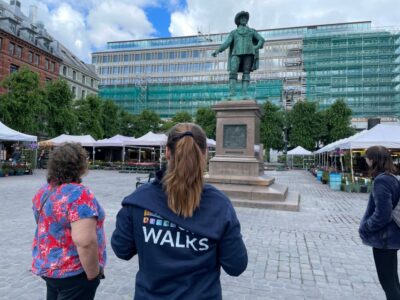
You begin at Tigeren in the Jernbanetorget square area, and this is a smart way to start. The tiger sculpture was erected in 2000 to commemorate Oslo’s millennium, and it’s become the quick visual shortcut to the city’s nickname. In practice, this stop does two useful things: it anchors your photos early, and it gives you a nickname to carry through the walk.
The sculpture is free to view, and you’ll spend around 10 minutes here. That’s just enough time to look closely, get a couple of pictures from different angles, and then move on while the group is still fresh.
If you’re the kind of traveler who likes context, this is where your guide can connect the nickname to how Oslo brands itself today. Even if you only catch part of the story while the group is gathering, you’ll feel like the route has a theme rather than random stops.
Oslo Opera House and Rådhusgata, new architecture plus old street life
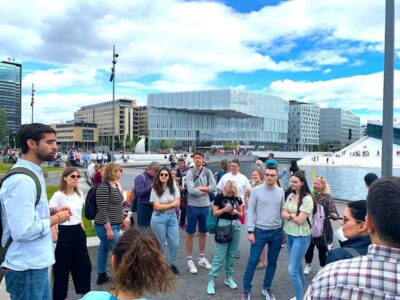
Next comes the Oslo Opera House area. It’s one of the city’s most recognizable contemporary buildings, completed in 2008, and known for its waterfront position and bold design. Since this tour stays outside, you get the best of both worlds: you can appreciate the building’s look and setting without turning your walk into a timed-ticket hunt.
Expect another short stop, roughly 10 minutes, focused on exterior views. If the light is right, you’ll get that clean look over the water, and you’ll also start seeing why Oslo puts so much emphasis on walking-friendly downtown space.
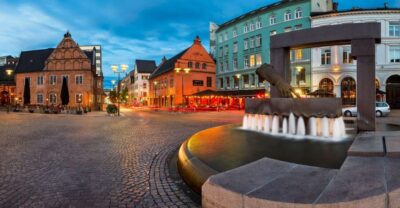
Then the route shifts to Rådhusgata, a historic street that dates back to the 1620s. This street runs through the central area leading toward Oslo City Hall, so it acts like a corridor between eras. You’re essentially watching how old street planning and civic identity feed into what you see today.
Pavement rivals threading Oslo


Akershus Fortress: medieval protection, now a museum site
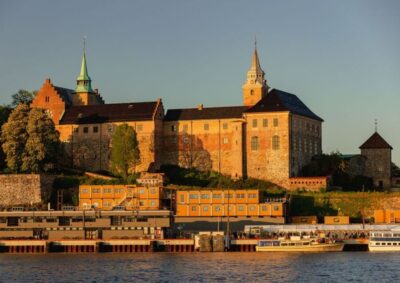
When the walk reaches Akershus Fortress, you’re stepping into one of Oslo’s most important historical zones. The fortress began in the late 13th century, around 1299, and it was built to help protect the city from invasions. Over time, it served multiple roles, including military base and prison, and it has since become a museum and historical site.
You do not go inside on this walk, but that doesn’t make the stop “less.” Fortress exteriors still teach you a lot: scale, placement, and how defensive design reads even before you enter any rooms. This is a great moment to slow down slightly and look for how the walls and surrounding space shape the view of downtown.
The timing here is about 15 minutes, and that’s enough to absorb what you’re looking at, listen for the main story beats your guide shares, and still keep the group moving.
Oslo City Hall and Nobel Peace Prize vibes, without the ticket hassle
After Akershus, you’ll move to Oslo City Hall, another major civic landmark. City Hall was constructed from 1931 to 1950 and is often described as a symbol of Norwegian administrative, social, and cultural ideals. It’s also famous for hosting the Nobel Peace Prize ceremony every year.
Even though you won’t be entering the building, you still get a sense of why this place matters. This is one of those stops where architecture is basically politics made visible. If you listen for your guide’s explanation, you’ll understand what Norwegian civic buildings want to communicate, not just what they look like.
You should expect around 15 minutes at this stop. It’s long enough to take photos and hear the key story, but not so long that you lose momentum for the rest of the walk.
Oslo Cathedral and Karl Johans gate, the Baroque landmark and the main drag
Then the walk shifts to the Oslo Cathedral, originally constructed in 1697. It’s known for Baroque architecture and has gone through renovations, including work in the 20th century. Even from the outside, you’ll likely notice the cathedral’s presence and how it anchors the area.
Cathedral time is about 10 minutes, which means the guide will focus on the essentials rather than trying to cover every detail. If you care about architecture, this is a good “taste” stop that can help you decide whether you want more later.
Next is Karl Johans gate, Oslo’s main street. It stretches from the Royal Palace area to Oslo Central Station and has historic buildings, shopping, and dining along the way. Established in the 19th century, it’s basically the spine of central Oslo life.
This part works well because it breaks the pattern of landmark-by-landmark with a more human, street-level vibe. You can look around, notice the mix of old and new facades, and start imagining where you’d like to stroll on your own.
Time here is around 10 minutes, so you won’t get “wandering freedom,” but you will get orientation.
Aker Brygge waterfront and the Storting building, democracy meets the docks
From the main street energy, the route goes to Aker Brygge, one of Oslo’s most popular waterfront districts. It started as a shipyard in 1854 and was transformed into the area you see now in the 1980s. The point of this stop is that you can shift from politics and religion to everyday city life: shopping, entertainment, and dining.
Expect another short outdoor stop. The value here is perspective. You get to see how Oslo balances civic institutions with a working-to-leisure waterfront story.
Then you’ll reach the Storting building, the seat of the Norwegian Parliament. It was constructed between 1861 and 1866, and it symbolizes Norway’s legislative authority and democratic values. Again, no entry on this walk, but the building’s role is the lesson.
This is one of the best segments for travelers who like seeing how power is expressed through space. The building is a key Oslo landmark, and your guide can help you read what you see in a way that feels practical, not academic.
Ending at the Royal Palace square, your next-day planning starts here
The tour finishes at the square in front of the Royal Palace (Det Kongelige Slott) at Slottsplassen 1. This is a satisfying ending because you get a clear “final frame” of central Oslo’s most iconic royal landmark. You also end right where you can decide what to do next with zero transit planning.
Even though the walk does not include inside visits, finishing here is useful. It sets you up for follow-on exploring nearby, especially if you want to pair this orientation walk with one or two longer stops on your own time.
Price and value: why about $16.94 feels fair for two hours
At $16.94 per person, this tour is priced like a serious value play. You’re paying mainly for the guided storytelling and the route design that strings together big landmarks without extra entry costs. Since the stops are free to view and the duration is about two hours, you’re not wasting time or money on ticket lines as you’d do with a more museum-heavy day.
The best way to judge value is to match it to your travel style. If you want a quick, guided overview to get your bearings, the guide’s work is the product, and it’s strong value. If you want extensive indoor access, this may not feel like a “complete package,” because the tour stays outside.
Pace, group size, and whether this walk fits your day
The tour caps at 27 travelers, and that can be a good thing. It’s still small enough for a guide to manage, but large enough that you’ll likely meet other visitors. Multiple guides are described as handling bigger groups well, keeping everyone together, and using audio so you can hear.
You should plan for steady walking across central Oslo. Most travelers can participate, and the route is designed for normal visitor movement, but it is still a city walking tour with multiple blocks. On a rainy day, it can still work, yet you’ll be more comfortable if you bring a light waterproof layer and grippy footwear.
The route also depends on good weather. If weather cancels the tour, you’ll be offered a different date or a full refund, so you’re not stuck losing the money.
The main tradeoff: exterior views only, so bring a plan for what’s next
The tour does not include entry into buildings. That means you’re seeing the landmarks from the outside, listening to the history and significance, and then deciding what to explore more deeply later.
This is not a drawback if you approach it like an orientation walk. It is a drawback if you want “one-and-done” sightseeing where every stop is hands-on inside. The fix is easy: use this tour to choose your top one or two indoor priorities after you understand the layout.
Also, while the experience rate is high, every tour depends on the guide on the day. Most guides are described as friendly, funny, and clear, with strong Q&A. In rare cases, some people found the information sparse, so if you care about depth, come ready with questions during each stop.
Who should book this Oslo guided walk
I think this is a great fit if you:
- Want a first-day orientation of central Oslo landmarks you can’t miss
- Like history tied to what you actually see, not just facts read from a screen
- Prefer a guided walk that stays mostly outdoors and avoids extra ticket logistics
- Enjoy architecture and civic stories, from Akershus to the Storting to City Hall
It’s less ideal if you:
- Want museum interiors or cathedral entry on the same schedule
- Hate city walking or want minimal time on your feet
- Expect a highly detailed “lecture style” breakdown at every stop, since the guide will keep moving to fit the full route
Should you book this Oslo walking tour?
Yes, book it if you’re planning a short Oslo visit and you want the city’s key symbols connected by a local guide in about two hours. At roughly $16.94, it’s a smart way to get context fast, especially with an English-speaking guide and a free-to-view set of stops.
Skip or add extra planning if inside access matters most to your trip. This is an exterior-focused introduction that helps you choose what to do next.
FAQ
How long is the central Oslo guided walking tour?
It runs for about two hours.
What does the tour cost per person?
The price is $16.94 per person.
Is the tour offered in English?
Yes, it is offered in English.
Does the tour include visits inside buildings?
No. The tour does not include visits inside buildings.
Where does the tour start and end?
It starts at TigerJernbanetorget (0154 Oslo) and ends in front of the Royal Palace at Slottsplassen 1 (0010 Oslo).
What is the group size limit?
The maximum group size is 27 travelers.
What happens if the weather is bad, or I need to cancel?
The tour requires good weather. If it’s canceled due to poor weather, you’ll be offered a different date or a full refund. Free cancellation is available up to 24 hours in advance for a full refund, with timing based on local time.
One Shortlist, Oslo





More Tour Reviews in Oslo



The Capital, Kept Going
Newest Oslo write-ups off our Norway desk
- Fjord Houseboat Cruise in Oslo. 100 % electric. BYO
★ 5.0 · 3 reviews - Oslo Christmas walk
★ 4.0 · 3 reviews - Afternoon Tea and Classic Concert on the Fjord
★ 4.5 · 3 reviews - Lake walk and campfire
★ 4.7 · 3 reviews - Oslo: Yoga & Hiking with a dog
★ 5.0 · 3 reviews - Oslo: Skjennungstoppen Wildlife Forest Hiking Tour
★ 5.0 · 3 reviews
More in Oslo Tours.
 ★ 4.5Oslo: Scenic Fjord Cruise with Audio Guide CommentaryFrom $445,375 reviews
 ★ 4.8Oslo Nature Walks: Island Hopping TourFrom $692,713 reviews
 ★ 4.4Oslo: 100% Electric Oslofjord Sightseeing CruiseFrom $402,041 reviews
 ★ 4.5Oslo: Fjord Evening Cruise with Shrimp BuffetFrom $881,956 reviews
 ★ 4.8Oslo: 3-Hour Highlights Bike TourFrom $621,609 reviews
 ★ 4.7Oslo: Guided Sightseeing Fjord Cruise on Premium Silent BoatFrom $641,390 reviews
 ★ 5.0Oslo Highlights Bike TourFrom $62979 reviews
 ★ 4.3Oslo: Paradox Museum Entry TicketFrom $29799 reviews
Lists this one sits in