
REVIEW · BERGEN TOURS
Walk with a Witch in 16th Century Bergen: A Self-Guided Fictional Tour
A witch tale turns Bergen into a time machine. This self-guided VoiceMap walk lets you follow a fictional witch through old streets and major landmarks like Bryggen and Holy Cross Church, without a real-time group to wait for. I like the lifetime access, and I like that you can play the audio with no WiFi once you have the app loaded.
The only real catch is GPS self-guided logistics: you will need your own smartphone and enough battery, and the start near Bergenhus can feel a bit far if you are starting from the cruise area.
In This Review
- Key Highlights You Should Care About
- A Witchy Audio Walk Through Bergen’s Medieval Heart
- How VoiceMap Self-Guided GPS Keeps You Moving (Offline, Too)
- Start at Bergenhus, Finish Near Nordnesbakken
- Bryggen Wharf: When Hanseatic Power Met Wooden Houses
- Holy Cross Church (Korskirken): 1100s Stone With a Fire-Fought History
- Kong Oskar’s Gate and Sutarestretet: The Shoemakers’ Street Story
- The Witch Story Thread: Making Tough History Easier to Remember
- What the Hour-and-Change Walk Feels Like in Real Life
- Price and Value: $8.99 for a Landmark Walk That You Can Replay
- Who This Tour Suits Best (and Who Might Want Another Option)
- Should You Book This Walk With a Witch in Bergen?
- FAQ
- How long is the Walk with a Witch in 16th Century Bergen?
- What does the tour cost?
- Is the tour available in English?
- Does it require WiFi?
- Where does the tour start and end?
- Can I cancel and get a full refund?
Key Highlights You Should Care About
- Lifetime access: start it anytime, revisit whenever you want
- Offline audio and maps: no WiFi needed once downloaded
- A storyline that adds meaning: the witch fiction points you at real history
- Big Bergen anchors on foot: Bryggen, Holy Cross Church, and the shoemakers’ street area
- Flexible pacing: pause, keep walking, and stop for snacks when the mood hits
Bergen leftovers, wharf and mountain both
- From Bergen: The Original Fjord Cruise to Mostraumen★ 4.7 · 8,440 reviews
- Bergen: Mostraumen Fjord & Waterfall Cruise★ 4.6 · 2,990 reviews
- Bergen: Past & Present Small Group Guided Walking Tour★ 4.9 · 1,609 reviews
- Walking Tour in Bergen of the Past and Present★ 5.0 · 1,575 reviews
A Witchy Audio Walk Through Bergen’s Medieval Heart
Bergen has a way of feeling layered. Even if you only have a day, you can bounce between waterfront trade power, church stonework, and plain old neighborhood streets. This Walk with a Witch in 16th Century Bergen setup takes that layering and ties it together with a fictional witch narrator, then matches the story to major landmarks you would otherwise skim.
I like how the tour is built for people who hate rigid schedules. You are not stuck with a single start time and a single walking pace. You get a route, then you choose how long you linger. If you want to read street details, check a view, or duck into a shop, you can. That matters in Bergen, where weather can change faster than your plans.
How VoiceMap Self-Guided GPS Keeps You Moving (Offline, Too)
This is a VoiceMap Audio Tours experience, meaning the “guide” is audio you follow while your phone tracks your progress. Practically, that gives you two advantages. First, you can pause and start again whenever you want. Second, it reduces the pressure to stay close to a guide.
The other key benefit is offline access. The tour includes offline audio, offline maps, and offline geodata in the VoiceMap app. So even if the city’s connectivity is spotty, you still have your directions and the story on tap. For a walking tour, that can be the difference between a smooth hour and a frustrating one.
One more practical note: a smartphone is not included. Bring your own, charge it before you leave, and consider plugging in headphones you can handle outdoors. If your battery tends to drain fast, start with a full charge and keep a power bank handy.
Start at Bergenhus, Finish Near Nordnesbakken
The route starts at Bergenhus 4 (Bergenhus area) and ends at Nordnesbakken 1. That end point is handy because it does not trap you in one pocket of the city. You will likely be able to connect onward using normal city movement, and the tour area is near public transportation.
Also, the tour is effectively available all day during its listed operating window (it shows 12:00 AM to 11:59 PM, every day). In real life, this matters because Bergen is unpredictable. If the rain hits, you can still choose a calmer moment to start rather than forcing your day around a strict departure time.
Pavement rivals threading Bergen
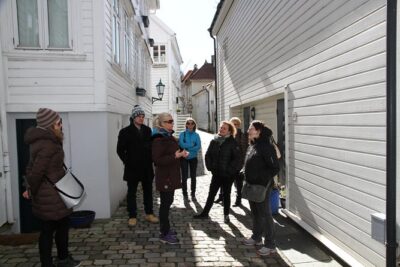

Bryggen Wharf: When Hanseatic Power Met Wooden Houses
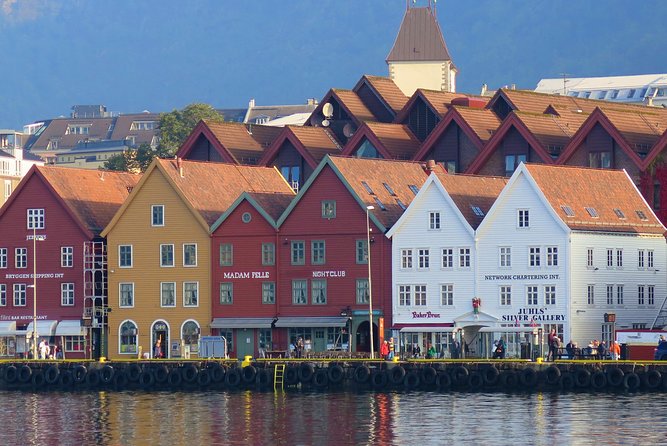
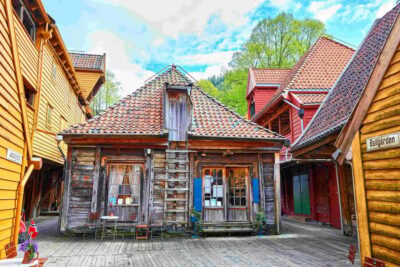
Your first major anchor is Bryggen, Bergen’s old wharf. This is where the city’s international trade mattered, especially during the Hanseatic League era, from the 14th century into the mid-16th century. If you only know Bryggen as a UNESCO-style photo stop, this is the push you need to understand why it looked the way it did and why it kept getting rebuilt.
Bryggen is famous for its rows of wooden buildings. The tour’s story also makes an important point: fires repeatedly ravaged the trademark houses. That recurring loss is not just background color. It explains why you feel a mix of eras in a place that looks like it should be frozen in time. Every time the wood burned, rebuilding changed the streets again.
What I like about using Bryggen as a first stop is that it gives you context fast. Once you grasp Bryggen as trade infrastructure, the rest of the walk makes more sense. You notice details with new eyes, like how close the buildings sit, how the waterfront connects to the idea of goods moving quickly.
Holy Cross Church (Korskirken): 1100s Stone With a Fire-Fought History
Next up is Holy Cross Church, also known as Korskirken. This church dates to the latter part of the 1100s. Even if you are not a church person, it is worth paying attention here because the building has seen lots of change. The tour notes numerous augmentations, reproductions, and rebuilding efforts through the ages.
And again, fire shows up as a major force in the story of Bergen. The church and town repeatedly suffered from fires, which meant the church was not a one-and-done construction. That means the church you see today sits on a long chain of repairs and alterations. You are not just looking at stone and glass. You are looking at survival.
A practical drawback to keep in mind: places like Korskirken can feel very “inside your head” if you are rushing. This kind of audio tour works best when you slow down enough to let the story land. If you try to sprint through, you miss the real payoff, which is connecting the physical building to the repeated rebuilding cycle.
Kong Oskar’s Gate and Sutarestretet: The Shoemakers’ Street Story
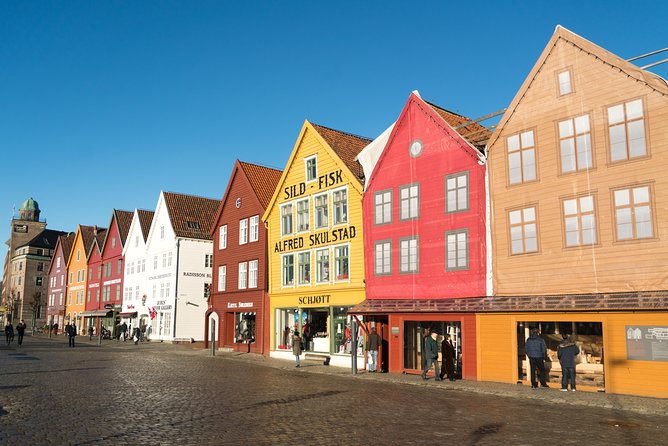
After Bryggen and the church, you move into street-level history at Kong Oskar’s Gate. The tour explains that this street’s identity used to be tied to the shoemakers. It was known as Sutarestretet, shoemakers’ street.
This stop is a smart move in a walking tour because it shifts you from grand landmarks to everyday work. Ships and churches are important, but craft streets show how the city functioned day to day. If you picture a trading port, you can also picture the people who needed boots, shoes, and repair work as goods, travel, and labor flowed through Bergen.
One reason I think this works so well in Bergen is that the city’s old streets are still walkable. When you hear the shoemakers’ street history while you are actually in the corridor of the old neighborhood, the story has weight. It feels less like trivia and more like a map of how people lived.
The Witch Story Thread: Making Tough History Easier to Remember
The whole concept is a “Walk with a Witch” framing, which sounds playful at first. The value comes from how the fictional voice points you at real tensions in the era. You may also hear a grim detail connected to witch accusations, including the fact that 350 women were condemned as witches over a 150-year period. That is dark history, and the tour uses the narrative tone to keep it from turning into a dry lecture.
This is not just about the witch theme as entertainment. It is about using a story to get you to pay attention to what you would normally pass by. When you connect the witch narrative to the city’s repeated rebuilding, you start to understand why communities feared things they could not control. You also see how rumor and panic can leave permanent marks on human lives.
If you dislike heavy topics or prefer strictly cheerful walking tours, you might want to treat the witch storyline as part history lesson, part fictional storytelling. You can still enjoy the walk, but expect that the tone can turn serious in moments.
What the Hour-and-Change Walk Feels Like in Real Life
The duration is listed as about 1 hour 10 minutes. In practice, that is a good length for an afternoon break, a cruise-day plan if timing works out, or a way to warm up before dinner.
A key strength of this format is flexibility. The self-guided GPS setup means you can stop and start on your schedule, which helps if you want a snack break or a short detour. One review-style sentiment that fits the design is that the experience feels relaxed, because you control when you move on.
Weather can be a factor in Bergen. One person specifically recommended the tour even in rainy conditions. That tells you something important: this route is built for walking, not for sitting inside a museum. If you bring a rain layer, a tour like this is still workable.
Price and Value: $8.99 for a Landmark Walk That You Can Replay
At $8.99 per person, this tour sits in the “low cost, meaningful time” category. You are paying for audio storytelling plus offline navigation support, not for a staffed guiding experience.
That makes it good value if you meet two conditions. First, you are comfortable using an app while walking. Second, you want to spend time on foot around the historic core. If you want a hands-on guide to stop and answer questions live, this is not that kind of product.
Where it really pays off is lifetime access. For that price, you can run it once now, then repeat it later when your memory is refreshed. It is one of the best ways to turn a single visit to Bergen into a longer-lasting understanding of the city.
Who This Tour Suits Best (and Who Might Want Another Option)
I think this Walk with a Witch in 16th Century Bergen is a strong fit if you want:
- Historic landmarks on foot without waiting for a group
- Offline-friendly audio for wandering time
- A story hook that makes streets and buildings easier to remember
It also fits solo travelers or small groups who like control over pacing. Since the activity is set up for your group only, you are not sharing the tour experience with strangers in a live-guide scenario.
On the other hand, it may feel less satisfying if you want the walking to stay strictly in the oldest areas the whole time. One comment pointed out that the route starts to shift toward more modern surroundings partway through. If that matters to you, be ready to enjoy the route for its range rather than expecting one long medieval bubble.
Should You Book This Walk With a Witch in Bergen?
If you are planning a walkable day in Bergen and you want a low-cost way to make Bryggen, Holy Cross Church, and nearby streets feel connected, I would book it. The combo of offline audio and maps, plus lifetime access, is the kind of value that keeps paying off after your trip.
Book it especially if you like history presented with a narrative frame, and if you are okay guiding yourself with VoiceMap on your phone. Skip it if you do not want app-based navigation, or if you prefer a live guide who can tailor the story to your questions.
Either way, bring charged phone power and rain protection. Then you can enjoy Bergen at your pace, with a witch leading you to the places you will remember.
FAQ
How long is the Walk with a Witch in 16th Century Bergen?
It is listed at about 1 hour 10 minutes.
What does the tour cost?
The price is $8.99 per person.
Is the tour available in English?
Yes, it is offered in English.
Does it require WiFi?
No. The tour includes offline access to audio, maps, and geodata, and it is described as no WiFi required.
Where does the tour start and end?
It starts at Bergenhus 4, 5003 Bergen, Norway, and ends at Nordnesbakken 1, 5005 Bergen, Norway.
Can I cancel and get a full refund?
Yes. Free cancellation is available up to 24 hours in advance for a full refund.
One Shortlist, Bergen


More Tour Reviews in Bergen


Bergen After Bryggen
Newest Bergen write-ups off our Norway desk
- Three-summit hike in Bergen
★ 5.0 · 3 reviews - PRIVATE GUIDED TOUR: King of the Fjords – round trip to the Sognefjord, 11 hours
★ 5.0 · 3 reviews - PRIVATE GUIDED TOUR: Norway’s Highlights – Viking Special, 11-12 hours – WINTER
★ 5.0 · 3 reviews - PRIVATE GUIDED TOUR: Secrets of the Fjords – the Osterfjord and Mo, 6-7 hours
★ 5.0 · 3 reviews - PRIVATE GUIDED TOUR: Folgefonna Glacier & Bondhus Valley from Bergen, 10 hours
★ 5.0 · 3 reviews - Bergen to Hardangerfjord VIP car + private yacht Fjord cruise
★ 5.0 · 3 reviews
More in Bergen Tours.
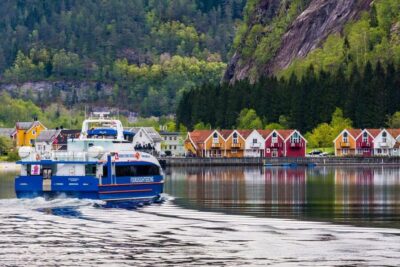 ★ 4.7From Bergen: The Original Fjord Cruise to MostraumenFrom $938,440 reviews
 ★ 4.6Bergen: Mostraumen Fjord & Waterfall CruiseFrom $812,990 reviews
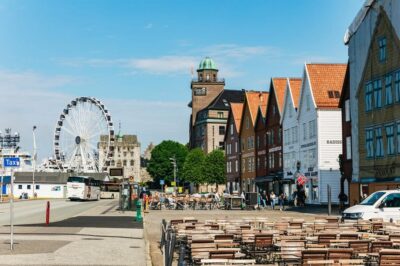 ★ 4.9Bergen: Past & Present Small Group Guided Walking TourFrom $261,609 reviews
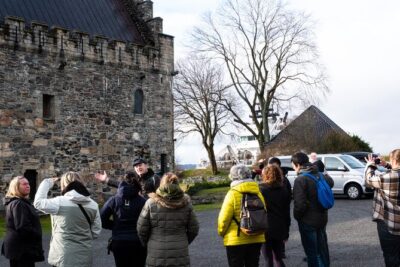 ★ 5.0Walking Tour in Bergen of the Past and PresentFrom $331,575 reviews
 ★ 4.9Bergen: City Tour on FootFrom $301,327 reviews
 ★ 4.8Bergen: Viking Village, Nærøyfjord Cruise & Flåm RailwayFrom $4181,047 reviews
 ★ 4.6Bergen: Round-Trip Ulriken Cable Car TicketFrom $51925 reviews
 ★ 4.5Mostraumen Fjord Cruise – the local operatorFrom $80742 reviews
Lists this one sits in