
REVIEW · BERGEN TOURS
Bergen City Cruise
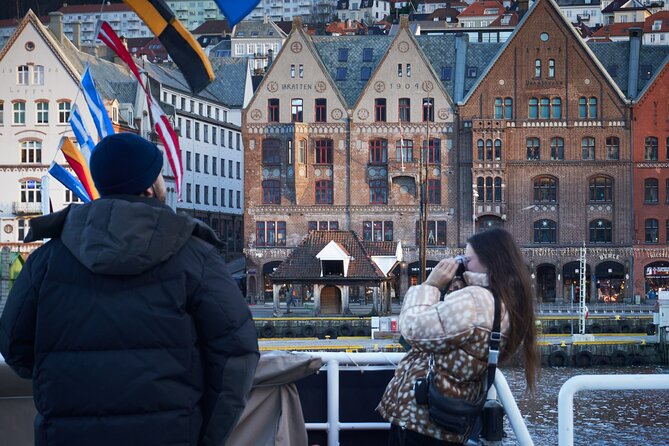
Bergen looks different from the water. This 1-hour cruise gives you a fast, story-filled way to connect Bergen’s waterfront to the city you’ll explore later, with narration as you glide by the landmarks.
I especially like two things. First, the on-water views make Bryggen and the fortress area feel real, not just like photos. Second, it’s a relaxing break from walking, even with kids or older relatives in the group.
One thing to think about: the narration is delivered by recorded audio, and in rough weather you may spend more time indoors, where sound and window clarity can be hit or miss, so plan to prioritize your seat on boarding.
In This Review
- Key things that make this cruise worth your time
- A 1-hour Bergen harbor cruise that helps you plan the rest of your trip
- The boat, the seating choice, and why the weather matters
- Bryggen and St. Mary’s Church, why this harbor is UNESCO-level important
- Bergenhus Fortress and Håkon’s Hall, the royal seat you can actually see
- Skuteviken, Sandviken islets, and the fjord that shapes the view
- War stories on the city fjord, plus the Bruno submarine bunker at Laksevåg
- From shipbuilding to USF Verftet: Georgernes Shipyard’s transformation
- Nordnes Peninsula highlights: Fort Fredriksberg, the seawater pool, and the aquarium
- Tollbod customs house, Nykirken, Murhvelvingen, and the fish market energy
- Practical tips to get the most from the cruise
- Should you book the Bergen City Cruise?
Key things that make this cruise worth your time
- UNESCO Bryggen from the harbor, with the Hanseatic wharf and medieval waterfront laid out in context
- Bergenhus Fortress and Håkon’s Hall sightings from the water, including what the royal seat meant
- WWII-era stops, including the Bruno submarine bunker at Laksevåg and war stories tied to the fjord
- Wooden-houses districts like Skuteviken and Sandviken’s islets, with the why behind their location
- A good time-boxed intro, so you can decide what to visit up close afterward
- Blankets for chilly weather, plus an easy overall duration for families and mixed ages
Bergen leftovers, wharf and mountain both
- From Bergen: The Original Fjord Cruise to Mostraumen★ 4.7 · 8,440 reviews
- Bergen: Mostraumen Fjord & Waterfall Cruise★ 4.6 · 2,990 reviews
- Bergen: Past & Present Small Group Guided Walking Tour★ 4.9 · 1,609 reviews
- Walking Tour in Bergen of the Past and Present★ 5.0 · 1,575 reviews
A 1-hour Bergen harbor cruise that helps you plan the rest of your trip
If you’re arriving in Bergen and you want to get oriented fast, this is a smart move. One hour sounds short, but the harbor view does a lot of work. You see the layers: medieval wharf buildings, royal stone fortifications, and modern waterfront districts, all lined up along the water’s edge.
At $28.97 per person, you’re paying for convenience and perspective more than for a museum experience. In exchange, you get a narrated route that covers major highlights you’d otherwise piece together with multiple long walks. And because it’s timed, it works even on a day when the weather turns or your legs need a breather.
The cruise also has a practical vibe. It’s not a fancy dinner-boat thing. It’s a sightseeing ride with blankets available when it’s cold, and it’s set up for all ages. In other words, this is the kind of activity that actually fits into a real itinerary, not just a perfect-weather fantasy day.
The boat, the seating choice, and why the weather matters
This is a comfortable vessel with blankets available when it’s chilly. That matters in Bergen, where cool wind coming off the water can turn a quick sightseeing plan into a miserable one if you’re unprepared.
You can choose to ride inside or outside, and the “best” choice changes with the day. When it’s dry and you can see well, aim to be on deck for the clearest photos. If it’s raining or cold, you may be happier inside, but you’ll want to find the spot with the cleanest view and the easiest audio access.
Also note how the narration is delivered. Some people love that it’s steady and clear, but it is recorded, meaning there’s less back-and-forth. If you like to ask questions or go off-script, this type of audio tour is more like listening along than chatting with a guide. I’d think of it as a guided drive-by in boat form.
Accessibility is built in. The experience is wheelchair- and stroller-accessible, and service animals are allowed. Still, getting on and off boats can be tricky in general, so if you’re traveling with a walker or wheelchair user, give yourself a little extra time and be ready for a slower boarding moment.
Bryggen and St. Mary’s Church, why this harbor is UNESCO-level important
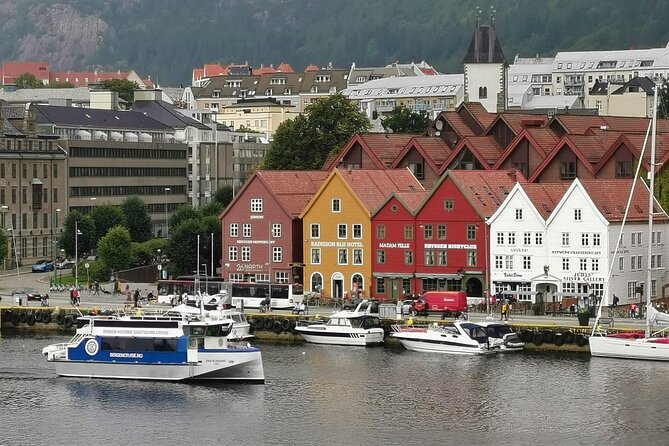
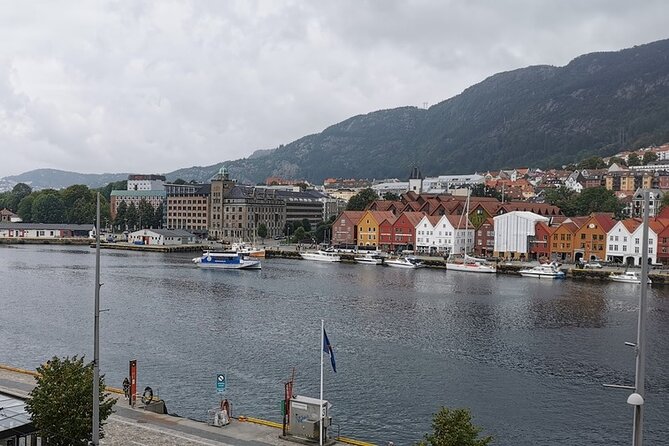
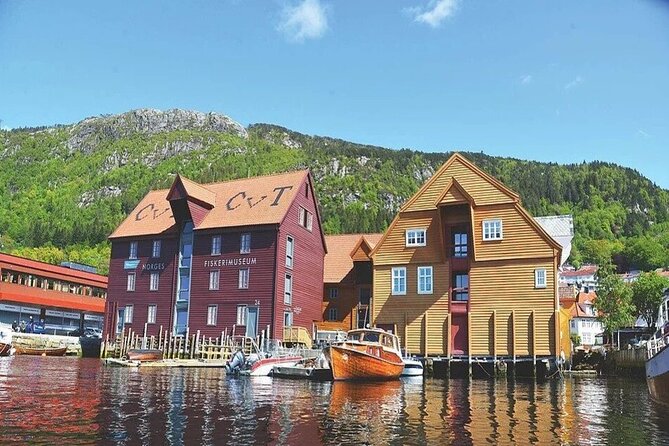
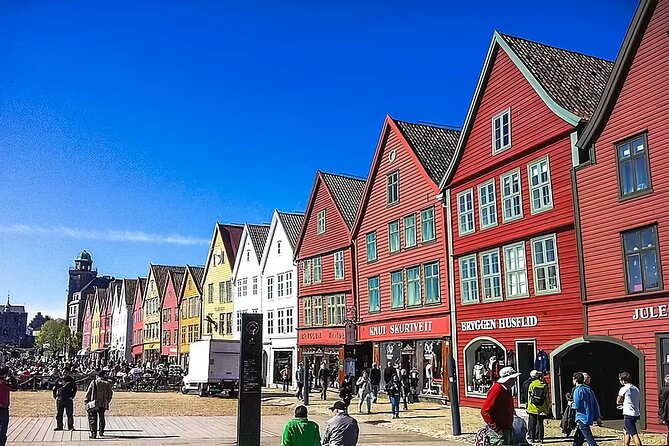
The cruise’s early focus is Bryggen, and that’s exactly where you want to start. Bryggen is one of Norway’s biggest attractions for a reason: it’s tied to the very first Bergen waterfront buildings, and it became a busy Hanseatic wharf area for centuries. On this cruise, you get to see it from the water, which instantly makes the UNESCO listing feel less like a label and more like a working waterfront story.
You also learn how the site is structured in heritage terms. The UNESCO area includes the old Hanseatic wharf and the buildings, and it’s described as one of the best known medieval urban waterfront areas in Norway. When you hear that while you’re floating alongside, it changes how you look at the colors and shapes. They’re not just pretty facades. They’re part of an old trade layout built around the harbor.
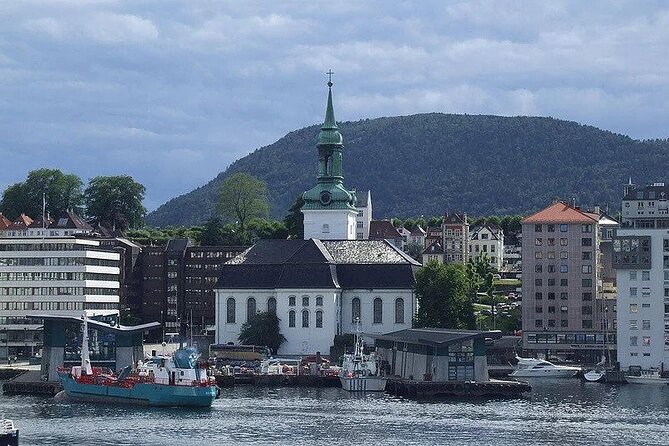
Then the narration moves to St. Mary’s Church, a highlight that many visitors only fully appreciate when they understand its timeline. Construction finished around 1180, and it’s the oldest remaining building in Bergen. It started as a parish church for the Norwegian population, then the German population took over in 1408, leading to richer adornment. The church’s basilica plan also gets explained, with a high nave and side aisles under separate roofs, which is less common in an ordinary parish church.
If you’re the type who likes “why this place looks the way it does,” these two early stops do a great job. You go from medieval harbor trade at Bryggen to medieval church power and influence with St. Mary’s. That’s how you get context fast.
Gunwale rivals, further Bergen sailings
Bergenhus Fortress and Håkon’s Hall, the royal seat you can actually see
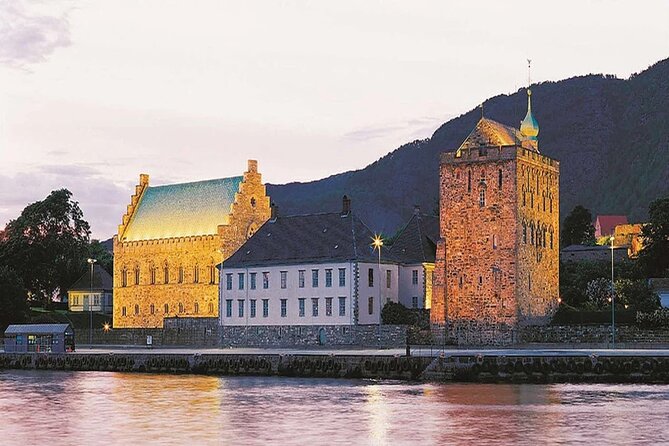
Next up, you’ll be in the area of Bergenhus Fortress and Royal Castle, which is one of Norway’s oldest and best preserved stone fortifications. The cruise narration places this site in a larger royal and religious setting, including references to Holmen, the medieval main seat of Norway’s rulers.
A key detail you’ll hear is that buildings in the area can date back as far as 1240, and excavations have even revealed foundations believed to date before 1100. That’s a lot of time packed into one shoreline stretch.
The royal focus lands on Håkon’s Hall, built in 1247. It was the largest and most imposing building of the royal residency in the 13th century. From the water, the fortress walls and the scale feel more believable than when you only look at them from street level. You also get a sense of why this location worked as a seat of power, surrounded by water access and protected stone.
Practical note: on a cruise, you can’t linger and read every plaque. So think of this segment as a trigger. If Bergenhus and Håkon’s Hall catch your interest, you’ll know where to aim once you’re back on land.
Skuteviken, Sandviken islets, and the fjord that shapes the view
After the core city highlights, the route shifts to neighborhoods that show how Bergen grew beyond the center.
Skuteviken is described as developing as an isolated suburb protected by Sverresborg fortress (built in 1183). You’ll learn that small wooden houses grew without one overall plan, with expansion continuing until the end of the 18th century. The name Skuteviken, meaning ship bay, connects to how merchants used the beach as a mooring spot when ships were to be keeled. That’s the kind of detail that helps you understand why the waterfront neighborhoods sit where they do.
Then the cruise turns attention toward the bay of Sandviken and Måseskjæret, one of three islets in that bay. The first settlement came in 1804 as a summer residence, and later, toward the end of the 19th century, more of the islet was developed. Today, the character you’ll hear about is modern apartment presence, but the narration anchors it in the earlier islet identity. If you’re surprised by how quickly the area evolved, the story explains why.
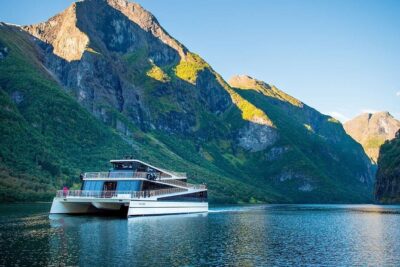
The route also references the 15-kilometer fjord separating Askøy from the Bergen Peninsula, passing north of the city. Even if you’re not mapping it perfectly, hearing that geography helps you interpret what you’re seeing beyond the immediate shoreline. Bergen’s views aren’t just city scenes. They are city meeting fjord.
War stories on the city fjord, plus the Bruno submarine bunker at Laksevåg
One of the strongest “value for your attention” parts of the cruise is the WWII segment, because it’s not abstract. The narration ties conflict to specific locations around the harbor.
You’ll hear about a naval battle on the City Fjord in 1665 during the Second Anglo-Dutch War, where an English and Dutch fleet clashed. A Dutch fleet of sixty ships, including ten from the Dutch East India Company, sought refuge in Bergen’s neutral port. The city forces joined on the Dutch side, and the battle was short and bloody, with the English fleeing. There’s even a detail about a cannonball being stuck in a cathedral wall that’s long been thought to come from this battle.
Then the cruise turns to WWII with the submarine bunker Bruno at Laksevåg. This story is heavy. The bunker was built into the mountains by German occupation forces from 1941, using enormous amounts of steel, sand, cement, and dynamite. The heavy work was done by Soviet prisoners of war. In October 1944, allied air attacks hit the bunker, and even though only a few bombs hit the target, many struck the settlement and killed 193 civilians, including 61 children at Holen school. The narration notes two planes were shot down and that the structure’s five-meter-thick concrete roof still hides three docks. In 1952, the facility was taken into use by the Norwegian Navy and it is still used today.
If you prefer lighter sightseeing, this is the segment where you might want to mentally steady yourself. But if you want your Bergen visit to be more than pretty waterfront photos, it’s one of the most meaningful parts of the cruise.
From shipbuilding to USF Verftet: Georgernes Shipyard’s transformation
War and fortifications show one side of Bergen. Then the narration shifts to industry and reinvention.
You’ll pass by the area of Georgernes Shipyard, built in the 1780s by Georg Brunchorst and Georg Vedeler. The heyday arrives with Annanias Dekke, who started building there in 1853 after learning shipbuilding in Boston. The story says he became known as one of Norway’s best ship designers and shipbuilders, and a series of magnificent sailing ships were built here.
Later, in 1910, a sardine factory was established in parts of the shipyard area, and it became one of Norway’s largest sardine factories. Today, that shipyard space is described as living a new life as USF Verftet, a 12,000 square meter art and culture arena with 120 companies.
This part of the cruise is valuable because it shows a pattern that repeats in port cities. The waterfront changes from trade to war to work, and then eventually, to culture and public use. Even from the water, you get a sense of the Bergen waterfront as a working system, not a frozen museum set.
Nordnes Peninsula highlights: Fort Fredriksberg, the seawater pool, and the aquarium
The route includes the Nordnes peninsula and several “everyday city” sights that make Bergen feel livable.
Fredriksberg Fortress sits on the highest point of Nordnes. You’ll get views over Bergen city center and toward Laksevåg, which helps you understand why this spot mattered defensively. In the 17th century, there were cannon batteries around the entire peninsula, and Fredriksberg itself was a military area until 1904. Later, it also served as a fire tower site, where shots told people where the city fire burned. The fire tower still stands.
Nearby, the cruise narration brings up Nordnes Sea Water Pool, known today as Nordnes Sjøbad. It opened in 1910 and the earlier version used floating wooden boxes attached with chains, until 1965 when the modern pool was ready. Today it’s a 25 meter heated saltwater swimming pool with a warm 29°C main pool temperature (plus sauna and changing rooms). That kind of detail is why I like harbor cruises with varied stops. It shows that the waterfront is used for recreation, not just industry.
And if you’re traveling with kids or you like animals, the cruise includes Bergen Aquarium. It’s a facility from 1960, showing fish and aquatic animals plus penguins. The aquarium includes more than 300 species and over 60 large aquariums, with a tropical section featuring snakes, crocodiles, spiders, and other animals. There’s also mention of a newer ocean aquarium opened in 2016, visible from outside and inside, with penguins, sea lions, otters, and large fish in outdoor ponds.
This is a good section for families because it’s less solemn and more about what you can do afterward if you want a rainy-day plan.
Tollbod customs house, Nykirken, Murhvelvingen, and the fish market energy
By the time the cruise nears the areas tied to city daily life, you’ll hear about trade, church life, and the marketplace culture that keeps Bergen moving.
The narration includes Bergen’s first customs house from 1561, which became the city’s largest wooden building. The jetties protruded more than 100 meters into the sea, allowing even large ships to dock. The Tollbod extension is also described as serving as shelter against northwest storms and narrowing Vågen to help prevent smuggling.
Next is Holy Trinity Church, consecrated in 1622, and widely known as Nykirken or the new church. The nickname makes sense because other churches in Bergen were already several hundred years old. Also, churches on this site burned and were rebuilt, so it was repeatedly the newest church.
Then you’ll hear about Murhvelvingen, built after a town fire in 1561 as a private house and representation for the sheriff of Bergenhus Fortress. It includes details about soapstone permission from monastery ruins, plus damage by fires in 1625, 1640, and 1643, followed by repairs funded by the public in 1651. You’ll also hear that the lower floor has shops in vaulted spaces, and that dynamite was sold in the basement until the late 1960s, allegedly enough to blow up the whole city.
That leads into the Fish Market in Bergen, which is described as one of Norway’s most visited outdoor markets, with centuries of meeting-place history. You can find fresh fish, shellfish, and local farm products, and there are many seafood restaurants nearby. The outdoor market runs May to September, while the food hall is open year-round. The narration also mentions historical boat sales from the quay, with fishermen rowing into the square from outside the city and returning the same day.
If you want a cruise that doesn’t only tell “big monuments” stories, this is why the last stretch works. It connects the waterfront to food and daily commerce, which is often what makes a port city feel like a place you want to return to.
Practical tips to get the most from the cruise
Here’s how I’d make this hour work best for you.
- Choose your seat with the weather in mind. If skies are clear, prioritize deck time for photos. If rain is steady, find a spot inside where sound is easiest and windows look clean.
- Treat this as an orientation tool. You won’t cover everything in an hour, but you will get enough context to pick your next walk confidently.
- If you’re bringing mobility equipment, plan for slower boarding and keep your expectations flexible. The experience is described as accessible, but boat transitions are still part of the reality.
- Pack for wind. Blankets help, but having a warm layer and a hat makes the difference between tolerating the water and actually enjoying it.
- If you dislike recorded narration, go in knowing it’s a one-way format. You’re there for the sights and the big picture explanations, not for a custom conversation.
Should you book the Bergen City Cruise?
If you want an easy, time-friendly way to see Bergen’s waterfront highlights, I think this cruise is a good booking. The 1-hour length makes it low-pressure, the on-water perspective is genuinely different from walking, and the route covers major sights like Bryggen, Bergenhus Fortress, and WWII landmarks without requiring you to do a long day of transfers and entrances.
I’d skip it only if you know you’re not a fan of recorded audio and you’re likely to ride mostly indoors in poor weather. In that case, you might prefer a land-based walking plan where you can control pace and stop when interest peaks.
If your goal is simple, get your bearings fast, see a UNESCO waterfront, and understand why the harbor shaped Bergen, this is a solid value for your first day.
Gunwales Around Bergen

More Tour Reviews in Bergen
Bergen After Bryggen
Newest Bergen write-ups off our Norway desk
- Three-summit hike in Bergen
★ 5.0 · 3 reviews - PRIVATE GUIDED TOUR: King of the Fjords – round trip to the Sognefjord, 11 hours
★ 5.0 · 3 reviews - PRIVATE GUIDED TOUR: Norway’s Highlights – Viking Special, 11-12 hours – WINTER
★ 5.0 · 3 reviews - PRIVATE GUIDED TOUR: Secrets of the Fjords – the Osterfjord and Mo, 6-7 hours
★ 5.0 · 3 reviews - PRIVATE GUIDED TOUR: Folgefonna Glacier & Bondhus Valley from Bergen, 10 hours
★ 5.0 · 3 reviews - Bergen to Hardangerfjord VIP car + private yacht Fjord cruise
★ 5.0 · 3 reviews
More in Bergen Tours.
 ★ 4.7From Bergen: The Original Fjord Cruise to MostraumenFrom $938,440 reviews
 ★ 4.6Bergen: Mostraumen Fjord & Waterfall CruiseFrom $812,990 reviews
 ★ 4.9Bergen: Past & Present Small Group Guided Walking TourFrom $261,609 reviews
 ★ 5.0Walking Tour in Bergen of the Past and PresentFrom $331,575 reviews
 ★ 4.9Bergen: City Tour on FootFrom $301,327 reviews
 ★ 4.8Bergen: Viking Village, Nærøyfjord Cruise & Flåm RailwayFrom $4181,047 reviews
 ★ 4.6Bergen: Round-Trip Ulriken Cable Car TicketFrom $51925 reviews
 ★ 4.5Mostraumen Fjord Cruise – the local operatorFrom $80742 reviews
Lists this one sits in